A social media campaign funnel is the strategic roadmap that turns followers into paying customers and loyal advocates. It explains how people move from discovering your brand to actively promoting it — a process that defines modern digital marketing success.
In social media marketing, visibility alone is not enough. You need a structure that connects every stage of user interaction — from awareness to action — with measurable goals. That structure is the funnel: a sequence of connected stages where content, timing, and engagement work together to create trust and drive conversions.
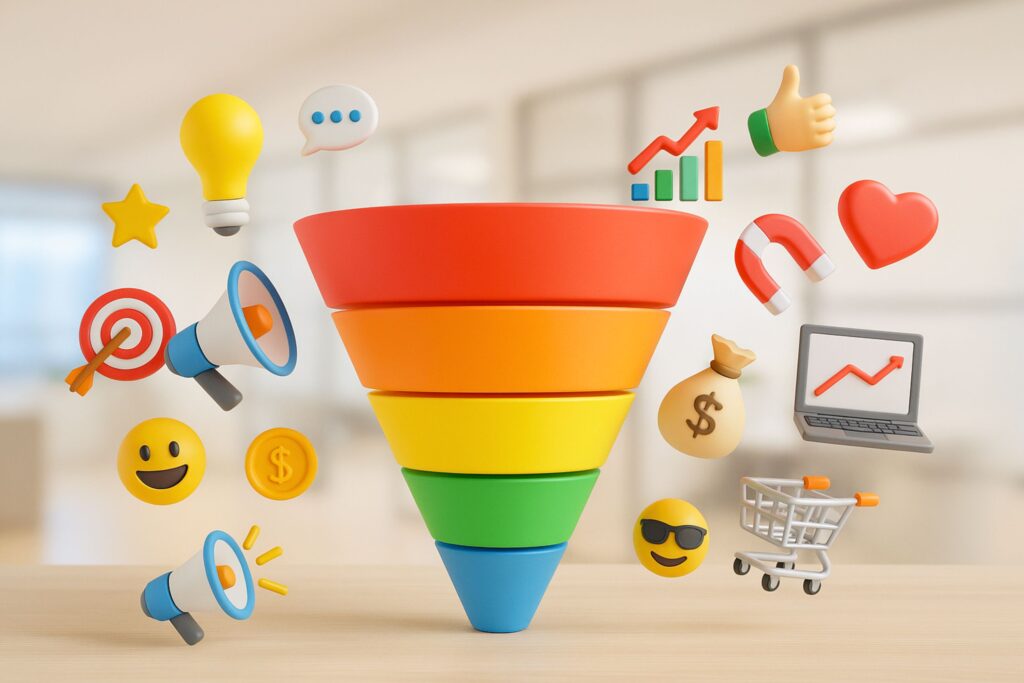
Each stage of this funnel — Awareness, Interest, Engagement, Action, and Advocacy — represents a milestone in your audience’s journey. Understanding how these stages interact helps marketers design campaigns that attract attention, build credibility, and motivate users to act.
With social media algorithms changing constantly, brands that use a funnel approach gain a clear advantage.
They track where followers come from, how they interact, and what triggers them to purchase or share. Instead of random posting, every activity becomes part of a data-backed process that fuels growth and customer loyalty.
Awareness in the social media campaign funnel
The awareness stage introduces your brand to people who haven’t heard of you before. It’s about visibility, recognition, and sparking curiosity. At this point, users are not ready to buy — they’re simply noticing that your business exists.
Building Awareness on Social Media
Effective awareness campaigns start by understanding your audience’s interests and where they spend time online. Short-form videos, relatable visuals, and storytelling make people stop scrolling. Hashtags and trending sounds increase discoverability, while paid ads extend reach to new audiences.
A consistent visual identity across platforms builds familiarity. The goal is to make users remember your brand name or associate it with a specific solution, even after just a brief interaction.
Smart Awareness Tactics
- Create visually engaging posts that highlight your brand personality.
- Use influencer collaborations to tap into existing communities.
- Run paid awareness campaigns targeting demographics similar to your ideal buyers.
- Engage with trending topics and challenges to increase your visibility in discovery feeds.
- Maintain clear, keyword-rich bios and branded visuals across all social profiles.
Track key metrics, including impressions, reach, profile visits, follower growth, and mentions. These show how many people have seen your brand and how often you appear in their feeds.
Establishing a strong social media marketing position is key to standing out in competitive digital spaces. Your brand’s position defines how audiences perceive your value, tone, and expertise across platforms.
By maintaining consistent visuals, messaging, and engagement style, you reinforce trust and authority — essential qualities for converting followers into loyal customers.
Expert Tip
At this stage, focus on recognition over conversion. People rarely buy what they have just discovered. Your goal is to be seen — and remembered when they start researching later.
Interest stage in social media funnel
The interest stage transforms passive viewers into potential customers. Users are aware of your brand and start exploring what you offer. They seek proof that you can solve their problem, fit their lifestyle, or align with their values.
Creating Interest Through Value
Interest grows when your content delivers useful, relevant information. Tutorials, product demos, and educational posts demonstrate expertise. Behind-the-scenes videos and authentic storytelling humanize your brand, showing that real people stand behind it.
Lead magnets — such as free guides, webinars, or checklists — give curious users something valuable in exchange for engagement.
Retargeting campaigns remind users of your brand after they interact with your posts or visit your website.
Strategies That Build Interest
- Post educational content that answers audience pain points.
- Share customer stories and use cases that show real results.
- Promote downloadable resources or limited-time offers.
- Encourage interaction through polls, questions, and quizzes.
- Utilize retargeting ads to re-engage viewers who have reached the awareness stage.
Click-through rate (CTR), website visits, downloads, video watch time, and post saves reveal how effectively you’re nurturing curiosity.
Creating the right social media content ideas for each stage of the funnel helps maintain audience interest and improve engagement rates. Posts that entertain at the top, educate in the middle, and inspire action at the bottom keep users moving forward.
When your team regularly brainstorms fresh content ideas based on audience insights and analytics, your campaigns remain relevant, consistent, and impactful.
Expert Tip
Interest is earned through relevance. Users don’t want to be sold to — they want to be informed. Make your content genuinely helpful, not promotional.
A strong social media communication strategy ensures that every message aligns with your brand voice and campaign goals. It defines how, when, and where you interact with your audience, turning casual followers into active participants.
By maintaining consistent tone, visual identity, and timing across platforms, brands create a recognizable presence that supports engagement and trust throughout the entire funnel.
Engagement in social media campaigns
The engagement stage bridges awareness and conversion. It’s where users start interacting with your brand — liking, commenting, sharing, or messaging. They’re not just aware of you; they’re beginning to trust you.
How to Deepen Engagement
Engagement happens when users feel seen and valued. Responding to comments, answering questions, and acknowledging feedback make your brand more approachable. Hosting live Q&As, challenges, or contests encourages participation and community growth.
Social platforms reward engagement. The more users interact with your content, the more it appears in feeds, thereby boosting organic reach.
But the actual value lies in forming emotional connections — building relationships that last beyond a single campaign.
Proven Engagement Tactics
- Create interactive content, such as polls, quizzes, and live events.
- Encourage user-generated content (UGC) through branded hashtags.
- Feature followers’ stories or reviews on your page.
- Leverage community-building spaces like Facebook or LinkedIn groups.
- Reply to every comment and DM to maintain a personal connection.
Engagement metrics, including comments, shares, saves, mentions, and direct messages, all indicate the health of your relationship with your audience.
Expert Tip
Engagement is a two-way process. Brands that listen and respond convert better than those that just broadcast. Treat followers as collaborators, not numbers.
Action stage in social media funnels
The action stage converts followers into customers. After multiple touchpoints, users are ready to take a step — make a purchase, book a call, subscribe, or download. This is where measurable business impact happens.
Converting Social Attention into Sales
At this stage, clarity and convenience are essential. The journey from social post to conversion must be seamless. CTAs should be clear, landing pages should be optimized, and offers should be compelling. Integrate shoppable posts, one-click links, and mobile-friendly designs to minimize friction.
Personalized retargeting strengthens conversions. Remind users who engaged but didn’t act, using dynamic content that matches their previous behavior — for instance, showcasing the exact product they viewed.
High-Impact Conversion Strategies
- Use persuasive CTAs like “Buy Now,” “Sign Up Today,” or “Reserve Your Spot.”
- Offer exclusive deals for social media followers.
- Display testimonials, ratings, and customer success stories.
- Optimize landing pages for speed, clarity, and mobile users.
- Run retargeting ads for users who engaged but didn’t complete checkout.
Conversion rate, cost per acquisition (CPA), click-through rate to landing pages, and revenue generated from social channels.
Expert Tip
Remove every barrier between interest and action. A slow website, unclear CTA, or broken link can destroy conversion potential. Simplicity drives results.
Advocacy in social media campaign funnels
The advocacy stage is where satisfied customers become your marketing team. They share positive experiences, post reviews, and recommend your brand to others. Advocacy is social proof at scale — the most trusted and cost-effective form of promotion.
How to Encourage Advocacy
Advocacy thrives on recognition. Thank customers publicly, share their stories, and give them reasons to stay connected. User-generated content, referral programs, and loyalty rewards transform one-time buyers into long-term ambassadors.
This stage also relies on continuous engagement. Reply to reviews, address feedback, and celebrate customer milestones. Each positive interaction reinforces loyalty and motivates repeat purchases.
Practical Advocacy Strategies
- Invite customers to share photos or videos using your products.
- Highlight testimonials and tag the original users.
- Launch referral programs with clear rewards.
- Offer early access or exclusive discounts to loyal followers.
- Create branded hashtags for community visibility.
Referral rate, repeat purchases, brand mentions, sentiment score, and the number of customers generating content about your brand.
Expert Tip
Advocacy builds trust faster than advertising. People tend to believe others, so amplify the voices that genuinely love your brand.
Optimizing the entire social media campaign funnel for maximum impact
A well-designed social media funnel connects every stage seamlessly. Each piece of content should have a clear goal — awareness posts attract, engagement posts nurture, and conversion posts close the deal.
Data and Personalization
Utilize analytics tools to monitor audience behavior and pinpoint areas where drop-offs occur. Segment users by engagement level or stage to deliver personalized messages. A one-size-fits-all strategy wastes effort; personalization increases relevance and conversion.
Understanding which social media metrics matter most allows marketers to measure real impact rather than vanity results. Metrics such as engagement rate, click-through rate, and conversion percentage reveal how well each funnel stage performs. Tracking these insights over time helps refine strategy, identify weak points, and prove the ROI of every social campaign.
Content Repurposing
Recycle high-performing posts into new formats. Turn videos into carousel graphics, or transform testimonials into case studies. Repetition strengthens brand recall and fills the funnel continuously with fresh, optimized content.
Continuous Testing
Social media behavior changes quickly – test visuals, captions, CTAs, and posting times. A/B testing reveals what resonates best with your audience and which stage of the funnel needs improvement.
Full-Funnel Thinking
The best social media campaigns don’t treat each stage separately — they connect them. A new follower from a viral post today could become a loyal customer tomorrow if guided strategically through the funnel.
To effectively run a social media campaign, focus on clarity and consistency. Each post should serve a purpose – raising awareness, driving clicks, or deepening engagement. By aligning goals with analytics and platform behavior, you create a campaign that performs efficiently across every funnel stage and delivers measurable growth.
Building a Successful Social Media Campaign Funnel
Mastering the five stages of the social media campaign funnel — Awareness, Interest, Engagement, Action, and Advocacy — transforms social platforms from posting channels into predictable growth engines.
Each stage builds on the previous one, moving users closer to brand loyalty through valuable content, trust, and interaction. By tracking metrics, refining strategies, and creating authentic engagement, marketers can transform their social media presence into a system that attracts, converts, and retains customers.
In the end, a well-structured funnel is more than a marketing model — it’s a reflection of how genuine relationships form online: attention, connection, trust, and loyalty.
FAQs
1. How does a social media funnel differ from a traditional marketing funnel?
A social media funnel focuses on audience behavior within digital platforms like Instagram, LinkedIn, or TikTok, while a traditional marketing funnel spans offline and online touchpoints. Social funnels prioritize engagement metrics, including shares, comments, and UGC (user-generated content), to drive users toward conversion and brand advocacy.
2. What role does content strategy play in each stage of the funnel?
A tailored content strategy ensures that each stage of the funnel speaks to user intent. Awareness needs eye-catching visuals; interest requires educational posts; engagement thrives on interaction; action demands clear CTAs; and advocacy depends on community storytelling. Matching content to intent accelerates conversions and brand loyalty.
3. How can social listening improve funnel performance?
Social listening tools track conversations around your brand, competitors, and industry trends. These insights reveal where users stand within the funnel and what type of social media content or message can move them forward. Monitoring keywords and sentiment also helps identify potential advocates early.
4. What are the best analytics tools for tracking funnel metrics?
Tools like Google Analytics, Meta Business Suite, Hootsuite, and Sprout Social allow marketers to analyze engagement rates, referral traffic, and conversions. These insights clarify how effectively each funnel stage performs, helping brands allocate resources where they yield the highest ROI.
5. How often should a brand audit its social media funnel?
A quarterly funnel audit is ideal for evaluating campaign performance. Regular reviews help spot audience drop-offs, outdated content formats, or ineffective CTAs. Consistent optimization keeps your funnel aligned with platform updates and user behavior shifts.
6. Can small businesses effectively use a social media funnel?
Yes. Small businesses benefit from structured funnels because they provide focus and scalability. Even with limited budgets, they can design stage-specific content, automate retargeting ads, and nurture customer loyalty through consistent engagement.
7. What KPIs are most important for measuring funnel success?
Each stage has distinct key performance indicators (KPIs): reach and impressions for awareness, CTR for interest, engagement rate for interaction, conversion rate for action, and referral or repeat purchase rate for advocacy. Tracking these ensures clear insight into where users progress or stall.
8. How can automation improve funnel efficiency?
Automation tools streamline repetitive tasks, including scheduling posts, sending follow-up messages, and retargeting campaigns. This allows marketers to maintain consistent communication while focusing on creative strategy and audience analysis, improving both efficiency and conversion rates.
9. What’s the link between customer journey mapping and the social media funnel?
Customer journey mapping visualizes the emotional and behavioral path of a user across platforms. It complements the funnel by identifying moments of friction or opportunity — ensuring that content and engagement align with real-world user experiences.
10. How do you identify leaks in your social media funnel?
Funnel leaks occur when users drop off before completing an intended action. By comparing engagement metrics to conversion data, brands can identify weak points — for example, a high CTR but low purchase rate may indicate poor landing page optimization or unclear CTAs.
11. How can influencer partnerships support different social funnel stages?
Influencer marketing enhances multiple stages of the funnel. Macro influencers drive awareness, while micro influencers nurture engagement and trust. Their authentic recommendations also support advocacy by encouraging user participation and sharing.
12. What future trends will shape social media funnels?
Emerging trends such as AI-driven personalization, social commerce, and predictive analytics are reshaping funnels. Platforms are integrating direct purchasing, conversational chatbots, and hyper-targeted content — making it easier to guide users from awareness to advocacy within a single social platform.
🚀 Subscribe for fresh strategies—🆕 new articles straight to your inbox, ✅ zero clutter.